






Technical Architecture and Spatial Optimization
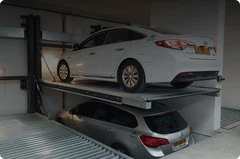
To address storage space limitations, Ollie-a professional automotive storage operator based in the UK-implemented 18units 3 levels hydraulic parking lift systems in two phases, resulting in a strategic upgrade in storage efficiency. The initial batch of six units was ordered in June and completed with installation and testing by September. These triple car parking lifts featured a blue-orange custom finish (RAL 5012 & RAL 2011), ISO 5817 B-grade welding standards, and millimeter-level lifting precision, all of which were well-received by the client. This positive outcome led to a follow-up order of twelve additional units with enhanced 2-meter lifting height in December.
Three-Layer Vertical Storage Configuration
Each workstation supports three vehicles stacked vertically. The 2m each floor high models are well-suited for storing larger vehicles such as Range Rovers.
Height and Load Specifications
▶ Phase 1 Equipment: 1800 mm per level; middle platform load capacity: 2500 kg; top platform: 2300 kg
▶ Phase 2 Equipment: 2000 mm (bottom layer), 1800 mm (middle layer); same load capacities as above

Commercial Value Delivered
Improved Storage Density
Deployment of 18 lifts significantly increased the capacity of two existing warehouses, avoiding the need for high-cost investment in new facilities.
Optimized Operating Costs
Storage cost per square meter was reduced by 57%. The projected payback period for the equipment investment is approximately 14 months.
Enhanced Operational Efficiency
● Electric-hydraulic lift system improved vehicle storage and retrieval efficiency by 40%
● Centralized control system allows real-time monitoring of lift status across all units
"This is far more cost-effective than building a new warehouse," Ollie noted during project handover.
Following the installation of the first phase, the storage area's output value increased from £125/m² to £410/m². The second-phase equipment introduced a dedicated SUV storage zone with hydraulic buffer platforms to reduce lifting shock, which contributed to a 65% increase in daily turnover for large vehicles.