




A garage floor in poor condition complicates car lift installation, leading many DIYers to ask, "Can I install a lift on my uneven or thin slab?" Fortunately, with meticulous planning and strict adherence to safety protocols, installation is often possible even on imperfect surfaces.
Why is floor condition so critical to lift safety?
Lift safety is fundamentally tied to floor condition. The columns transmit immense, concentrated forces-amounting to thousands of pounds-directly to the concrete. A slab that is thin, uneven, or compromised directly threatens the stability of the entire structure, making the floor the essential foundation for a secure installation.
Adhering to Manufacturer Specifications
- Compliance with the lift maker's concrete requirements-specifically minimum thickness and compressive strength (PSI)-is non-negotiable to prevent cracking or shifting under load.
- The substrate must be level, solid, and capable of distributing weight uniformly beneath each column base.
- Prior to any work, verify your slab meets these published specs through direct measurement and documentation. Never operate on assumptions.
Consequences of Inadequate Flooring
- Using a substandard slab can result in the lift tilting, sinking, or catastrophic collapse.
- Damage progresses swiftly: reinforcing steel may bend, concrete can fracture, and severe risk to both vehicles and personnel arises.
- The expense of repairing a failed floor post-installation vastly outweighs the cost of proper preparatory work.
Standard Concrete Benchmarks
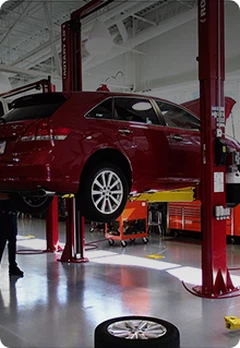
For most residential and light-duty two-post lifts (7,000–10,000 lb capacity), a continuous, monolithic slab of at least 4 inches thickness with 3,000 PSI compressive strength is generally adequate, provided it is sound and level.
Higher-capacity models (12,000 lbs and above) typically demand a 6-inch slab rated at 3,500 PSI or greater.
Specifications at a Glance
- Standard Two-Post Lift (≤ 10,000 lbs): 4-inch slab, 3,000–3,500 PSI, fully cured (28+ days). Incorporating reinforcement is highly advised.
- Heavy-Duty Two/Four-Post Lift (12,000–15,000 lbs): 6-inch slab, ≥ 3,500 PSI. Capacities exceeding 16,000 lbs may require 8 inches.
- Reinforcement: Steel rebar or mesh significantly boosts strength and mitigates cracking. A reinforced 4-inch slab offers greater safety than an unreinforced one.
- Placement: Column bases must be positioned away from expansion joints, cracks, or cold joints. If intersection is unavoidable, a dedicated concrete footing must be poured.
Four-post lifts disperse weight over a larger area (approx. 4 ft² per post). Consequently, many residential models can function without anchors on a level 4-inch/3,000 PSI slab, which accounts for their inherent stability. Always consult the manual, as heavy-duty four-post models or alignment racks may still specify anchoring.
Key Points for Four-Post Lifts:
Stabilization without bolting is achievable on a solid, level slab; precise leveling and runway alignment are as crucial as slab thickness.
Anchoring is advisable for intensive use, heavy-duty workshop applications, or questionable subsoil conditions.
A practical benefit is preserved flexibility: unanchored lifts can be fitted with caster kits for mobility while maintaining stability on compliant concrete.
If slab compliance is uncertain, confirm it beforehand. Determine thickness via a careful test core or construction plans. For older, well-maintained concrete, a compressive strength of approximately 3,000 PSI can often be assumed unless evidence indicates otherwise. When in doubt, address the base preparation immediately-it is far more economical than repairing a cracked slab or damaged equipment later.

Addressing Uneven Floors
While a minor slope is often tolerable, significant unevenness introduces a serious hazard. Misaligned columns cannot remain plumb, creating asymmetric loading and geometric distortion. Even a 1-inch deviation can induce a noticeable tilt on the lift carriage, potentially causing vehicle slippage, unreliable lock engagement, and excessive stress on anchoring systems.
Practical Impacts of Unevenness:
- Load distribution becomes uneven, overburdening individual columns.
- An unlevel carriage or arms may allow the vehicle to shift during hoisting.
- Safety locks might fail to engage simultaneously, compromising redundant protection.
- Anchor bolts and base plates endure additional shear forces, reducing service life.
Professional installers view excessive shimming as a red flag-requiring more than about 1/2 inch of shim at any post indicates an unsuitable surface. Furthermore, thick shim stacks reduce the effective embedment depth of anchors (e.g., a 1-inch shim reduces bolt embedment by 1 inch), critically weakening the connection. The principle is clear: first achieve vertical and parallel posts; then all components-locks, arms, runways-will operate as intended.
Corrective Measures:
- Professional Leveling: Grind down high spots or apply a leveling compound/epoxy. For severe slopes, cut out and repour a level section to ensure even load distribution.
- Manufacturer-Approved Steel Shims (Minor Adjustments): Employ thin, full-contact metal shims (e.g., 1/16" to 1/8") for fine-tuning plumb. Avoid wood or improvised materials, and cease if shim piles become excessive.
- Relocate the Lift: Survey multiple spots; a flatter area might preclude concrete work (ensure adequate ceiling and door clearance).
- Anchor Bolt & Washer Strategy (Guided by Pros): Secure the anchor on the lower side; on the higher side, use washers sparingly. Employ longer bolts if needed and torque to specification.
WARNING: Refrain from installing on a significantly sloped surface without correction. While heavy shimming might create a "barely fits" scenario, stacks exceeding roughly 1/2 inch (≈1.3 cm) introduce severe risks. The lift may function but with flawed geometry-latches engaging unevenly, vehicle tilting, and imbalanced structural stresses. Always prioritize achieving level and parallel columns for safe operation.

Hazards of Thin Slabs
Concrete that is too thin or weak presents an inherent anchoring hazard. A slab below specification (e.g., only 2–3 inches thick or lacking reinforcement) cannot properly disperse column loads or securely retain anchors, leading to cracking, anchor pull-out, instability, or sudden failure.
Failure Modes for Inadequate Slabs:
- Cracking/Fracture: Concentrated loads induce radial cracks propagating from anchor points.
- Anchor Pull-Out: Inadequate embedment depth and poor concrete quality allow tension anchors to loosen or detach.
- Flexing/Instability: Thin concrete may deflect, causing column tilt and dangerous sway-especially with a raised vehicle.
Indicators of Non-Compliance:
- Measured thickness falls below the manufacturer's stated minimum.
- Anchors spin in their holes, refuse to torque properly, or crush the surrounding concrete.
- Visible flexing, propagating cracks, or a "spongy" feel under load.
- Absence of reinforcement where it is expected.
Viable Repair Strategies:
- Pour Reinforced Concrete Footings: At each column location, excavate a 3'x3' or 4'x4' section to the required depth and pour a high-strength, reinforced pad at least 6 inches thick. Install columns only after full curing.
- Repour or Overlay the Area: Apply a bonded topping mix or completely repour the concrete to meet thickness, PSI, and reinforcement specifications.
- Engineer-Approved Anchoring Methods: Only implement solutions endorsed by the lift manufacturer or a qualified structural engineer; note that many still necessitate new concrete for safety.
Prohibited Actions:
- Avoid "Quick Fixes": Epoxy enhances bond but does not augment the slab's load-bearing capacity.
- Do Not Rely Solely on Steel Plates: While plates offer some load distribution, they cannot enable a 2-inch slab to perform like a 4-6 inch one.
- Never Use Excessive Shims: These reduce anchor embedment without improving concrete strength.
Seek Expert Consultation First
Always verify concrete thickness (via core sample or plans) and quality pre-installation.
Discuss certified remedies with the manufacturer/installer-such as longer anchors, through-bolts with backing plates, or load limits-and understand implications for the warranty.
Often, the prescribed solution is to repour concrete to meet specifications, thereby preserving warranty coverage.

Working with Post-Tensioned (PT) Slabs
PT slabs contain high-tension steel tendons; blind drilling is strictly forbidden. A misplaced drill hole can sever a tendon, causing concrete to explode and compromising the slab's structural integrity. Assume a slab is PT until a qualified professional confirms otherwise.
Safe Identification of a PT Slab:
- Search for stamps or labels reading "post-tensioned" near garage doors or slab edges.
- Examine property documents, builder plans, or municipal records for structural details.
- Engage a structural engineer to review drawings and conduct a slab scan (using ground-penetrating radar or X-ray) to map tendon locations.
- Obtain a written, stamped recommendation specifying "no drilling" or approved drilling zones/depths.
- Maintain the tendon layout diagram and approval documents with your lift records for warranty and insurance purposes.
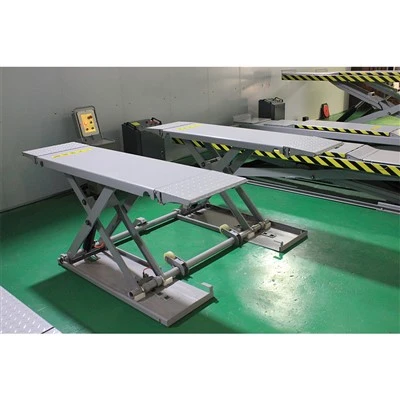
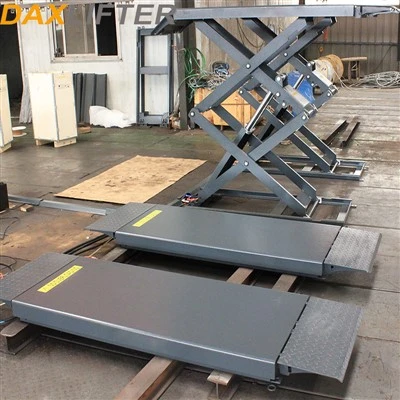
For most PT slab owners, a no-drill approach is the default and safest choice. Freestanding four-post lifts, when correctly positioned on a flat, solid slab, offer excellent stability; adding casters preserves mobility. Scissor lifts and low-rise pad lifts sit directly on the floor, facilitating tire, brake, and chassis work without any concrete penetration.
No-Drill Options & Guidance:
- Freestanding Four-Post Lift: Level the runways as instructed, deploy locking feet and wedges; add a caster kit for repositioning.
- Scissor Lifts / Low-Profile Pad Lifts: Ideal for maintenance in confined spaces; ensure complete pad contact on a flat floor.
- Mobile Column Lifts: Offer high capacity without anchoring; better suited for truck/fleet service but come at a higher cost.
- Portable Two-Post Lifts (Shallow-Anchor Type): Use only after an engineer maps safe zones/depths; otherwise, select a genuine no-drill alternative.
Maintain a flat, clean, and level floor, and rigorously observe rated capacities and operating procedures.
If anchoring a full-height two-post lift on PT concrete is absolutely necessary, treat it as a dedicated engineering project. The budget must include scanning, engineered drawings, and precise depth control-taking shortcuts is inadvisable. In many residential garages, the cost and complexity make a no-drill lift the preferred final choice.
Engineered Anchoring (Strictly Professional Process):
- Use GPR/X-ray to map tendons and designate safe zones; obtain stamped drawings from an engineer.
- Use only specified anchor types and embedment depths; equip drills with depth-stop collars.
- Drill exactly at marked locations; clean and prepare holes per anchor specifications.
- Perform torque/tension testing as specified; retighten after initial cycling if required.
- Document all steps (scan report, layout plan, torque log) for inspection, warranty, and insurance.
Conclusion for PT Slabs: No-drill solutions are safest and simplest. If anchoring is unavoidable, ensure a fully engineered design-never rely on guesswork or trial-and-error.

Alternatives for Problematic Floors
Not every application requires a full-height, anchored two-post lift. Selecting equipment suited to your slab's condition-whether thin, sloped, or post-tensioned-can provide a solution without risky drilling. First define your primary need: storage versus frequent maintenance. Then select a system compatible with your floor, rather than forcing a mismatch.
1. Freestanding Four-Post Lift (Storage-Oriented)
By distributing weight across four corners, this type remains stable on a solid, level 4-inch/3,000 PSI slab. It is excellent for vehicle stacking and light maintenance, eliminating anchoring concerns. A caster kit adds mobility in tight spaces.
Procedure: Level runways per manual; install locking feet; minimize shimming to ensure even load at all corners.
The ideal first choice for PT slabs or concrete of uncertain quality.
2. Portable Low/Mid-Rise Scissor Lifts
These ground-based units enable brake, tire, and suspension work without permanent installation. Their wide contact area helps distribute loads (within ratings) across thinner slabs. They can be deployed when needed and stored away.
Procedure: Verify floor flatness and full pad contact before lifting; adhere strictly to rated capacity and designated lift points.
Perfect for rental properties or locations with strict no-drill policies.
3. Plan Concrete Upgrades Proactively (Dedicated Footings)
If building or renovating, concentrate strength at future column locations. A reinforced, isolated footing or thickened strip will support virtually any lift type later.
Procedure: Integrate reinforcement with the surrounding slab; allow concrete to fully cure before anchoring; document all specifications for warranty/insurance.
4. No-Hole & Minimal-Hole Equipment
Efficient work is still possible when a large lift is impractical. Portable electric jacking systems and quality vehicle supports can handle routine maintenance without anchors, preserving flexibility.
Procedure: Always chock wheels and use appropriate supports; for maintenance pits, ensure adequate ventilation and safety measures.
Serves as a sound interim solution until a proper foundation can be installed.
Rapid Selection Guide
Match your primary use case and floor constraints to proceed confidently. For owners with PT or questionable slabs, starting with a no-drill option is usually best. Concrete can be upgraded later if a two-post lift is desired.
Primary Use: Storage & Light Maintenance → Freestanding four-post lift (+ caster kit).
Frequent Under-Vehicle Work / Low Ceilings → Mid-rise scissor lift.
PT Slab / No Drilling Permitted → Any aforementioned no-drill solution.
Future Two-Post Lift Planned → Pour reinforced footings during construction/renovation.
If uncertainties arise, halt installation and consult a professional-safety must always take precedence over expediency.