



Hey there! As a supplier of parking garage lifts, I often get asked some pretty interesting questions. One that pops up quite a bit is, "Can a parking garage lift be used on a sloped surface?" Well, let's dive right into this topic and break it down.
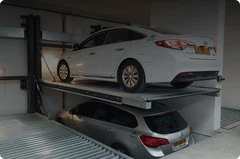
First off, let's understand what a parking garage lift is. It's a nifty piece of equipment that helps you maximize your parking space. Whether you're a homeowner looking to stack cars in your garage or a commercial parking lot owner trying to fit more vehicles in a limited area, these lifts are a game - changer. We offer some great options like the DAXLIFTER Home 4 Post Auto Car Hoist Stacker Parking Lift with Custom Service, the DAXLIFTER 4 Four Post Indoor Outdoor Commercial Vehicle Parking Lift, and the DAXLIFTER 2.3t - 3.2t 2.1m Home 2 Double Car Vehicle Storage Stacker Parking Lift. These lifts are designed to be sturdy, reliable, and efficient.
Now, back to the question at hand - using a parking garage lift on a sloped surface. In theory, it might seem like a good idea. Maybe you have a garage or parking area that has a bit of a natural slope, and you're thinking, "Why not use it?" But in reality, it's not that simple.
Parking garage lifts are typically designed to operate on a flat and level surface. There are a few reasons for this. One of the main reasons is safety. When a lift is on a slope, the weight distribution of the vehicle on the lift becomes uneven. This uneven weight distribution can put extra stress on certain parts of the lift, like the cables, hydraulic systems, or the structural frame. Over time, this can lead to premature wear and tear, and in the worst - case scenario, it could cause the lift to malfunction or even collapse.
Let's say you park a car on a lift that's on a slope. The car will naturally want to roll down the slope. Without proper leveling, the lift's locking mechanisms may not engage correctly. This means that the car could potentially move while it's on the lift, which is a huge safety hazard. You don't want a car suddenly sliding off a lift and causing damage to the vehicle, the lift, or even injuring someone.
Another issue is the accuracy of the lift's operation. Most parking garage lifts use sensors and control systems to ensure that they lift and lower the vehicle smoothly and evenly. These systems are calibrated for a flat surface. When the lift is on a slope, the sensors may not work as intended. The lift might not lift the vehicle to the correct height, or it could tilt during the lifting process, making it difficult to park and retrieve the car safely.


However, that doesn't mean it's completely impossible to use a parking garage lift on a sloped surface. There are some solutions, but they come with their own set of challenges.
One option is to build a level platform on the sloped surface. This could involve pouring a concrete pad or using some other type of leveling material. But this can be a costly and time - consuming process. You need to make sure that the platform is strong enough to support the weight of the lift and the vehicle. You also need to ensure that it's properly installed and leveled to within a very small tolerance.
Another option is to look for a specialized lift that's designed for sloped surfaces. While these types of lifts are less common, there are some manufacturers out there that offer them. But they tend to be more expensive than standard lifts, and they may have limited availability.
If you're really set on using a lift on a sloped surface, it's crucial to consult with a professional. A structural engineer or a lift installation expert can assess your specific situation and give you advice on the best course of action. They can help you determine if it's even feasible to use a lift on your sloped surface and what steps you need to take to make it safe.
In my experience as a parking garage lift supplier, I always recommend using a lift on a flat surface whenever possible. It's the safest and most reliable option. But if you have a unique situation where a sloped surface is your only choice, don't give up hope. Just make sure you do your research, consult with the right people, and take all the necessary precautions.
When it comes to choosing a parking garage lift, there are a few things to keep in mind. First, consider the weight capacity of the lift. You need to make sure that it can handle the weight of your vehicle. Also, look at the lift's features, such as the lifting speed, the type of locking mechanism, and the ease of use. Our DAXLIFTER lifts are designed with these factors in mind, offering high - quality performance and user - friendly features.
If you're in the market for a parking garage lift, whether for your home or a commercial property, I encourage you to reach out. We're here to help you find the right lift for your needs. We can answer all your questions, provide you with detailed product information, and even assist with the installation process. Don't hesitate to get in touch and start the conversation about how we can help you make the most of your parking space.
In conclusion, while it's possible to use a parking garage lift on a sloped surface, it's not without its challenges. Safety should always be your top priority. By choosing a high - quality lift and following the proper installation and usage guidelines, you can ensure that you have a reliable and safe parking solution.
References
- Industry standards for parking garage lift design and safety
- Manufacturer's guidelines for parking garage lift installation and operation
- Engineering principles related to weight distribution and structural stability