





What is the average payback period for a car parking lift system?
As a supplier of car parking lift systems, I often get asked about the average payback period for these innovative solutions. The payback period is a crucial metric for businesses and property owners considering investing in a car parking lift system, as it helps them understand how long it will take to recoup their initial investment through cost savings and additional revenue.
In this blog post, I'll delve into the factors that influence the payback period of a car parking lift system, provide some real - world examples, and offer insights on how to calculate it for your specific situation.
Factors Affecting the Payback Period
1. Initial Investment
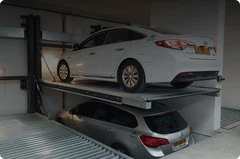
The upfront cost of a car parking lift system can vary significantly depending on the type, size, and features of the system. For instance, a basic two - level semi - automatic system like the DAXLIFTER 2 Level Customized Multi - platform Semi Automatic Car Parking System will generally have a lower initial cost compared to a multi - level smart automatic system such as the DAXLIFTER Multi - level Customized Smart Automatic Multi - platform Car Parking System. The initial investment includes the cost of the equipment, installation, and any necessary site preparation.
2. Operating Costs
Operating costs play a vital role in determining the payback period. These costs include electricity for running the lift, maintenance and repair expenses, and labor costs if the system requires manual operation. A more advanced and automated system may have higher initial costs but could potentially lower operating costs in the long run due to reduced labor requirements and energy - efficient designs.
3. Revenue Generation
One of the main ways to recoup the investment in a car parking lift system is through increased revenue. By maximizing the number of parking spaces in a limited area, property owners can charge more for parking or accommodate more customers, leading to higher income. The location of the parking facility also affects revenue; a system in a high - demand area such as a city center or near a popular commercial district is likely to generate more income than one in a less busy location.
4. Usage Rate
The frequency of use of the car parking lift system is another important factor. A system that is used frequently will generate more revenue and potentially have a shorter payback period. Factors such as the type of establishment (e.g., a shopping mall, office building, or residential complex) and the local parking demand will influence the usage rate.
Real - World Examples
Let's consider two scenarios to illustrate how the payback period can vary.
Scenario 1: A Small Office Building
A small office building in a suburban area decides to install a DAXLIFTER 2 Level Customized Multi - platform Semi Automatic Car Parking System. The initial investment, including equipment and installation, is $50,000. The operating costs, including electricity and maintenance, are estimated to be $2,000 per year. The building currently has 20 parking spaces and the new system will increase the number of spaces to 30. By charging an average of $10 per parking space per day and assuming a 70% occupancy rate, the additional revenue generated per year is approximately $36,500 (10 additional spaces * $10 per day * 365 days * 0.7).
To calculate the payback period, we first need to find the net annual cash flow. The net annual cash flow is the additional revenue minus the operating costs, which in this case is $36,500 - $2,000 = $34,500. The payback period is then calculated by dividing the initial investment by the net annual cash flow. So, $50,000 / $34,500 ≈ 1.45 years.
Scenario 2: A Large Shopping Mall
A large shopping mall in a city center installs a DAXLIFTER Multi - level Customized Smart Automatic Multi - platform Car Parking System. The initial investment is $200,000. The operating costs are higher due to the complexity of the system, estimated at $10,000 per year. The mall currently has 200 parking spaces, and the new system will increase the number to 350. By charging an average of $15 per parking space per day and assuming an 80% occupancy rate, the additional revenue generated per year is approximately $657,000 (150 additional spaces * $15 per day * 365 days * 0.8).
The net annual cash flow is $657,000 - $10,000 = $647,000. The payback period is $200,000 / $647,000 ≈ 0.31 years, or about 3.7 months.
Calculating the Payback Period for Your Situation
To calculate the payback period for your car parking lift system, follow these steps:
- Determine the initial investment: This includes the cost of the system, installation, and any site preparation.
- Estimate the operating costs: Consider electricity, maintenance, and labor costs.
- Calculate the additional revenue: Estimate the number of additional parking spaces, the average parking fee, and the occupancy rate.
- Calculate the net annual cash flow: Subtract the operating costs from the additional revenue.
- Calculate the payback period: Divide the initial investment by the net annual cash flow.
Conclusion
The average payback period for a car parking lift system can vary widely depending on the factors mentioned above. In general, systems in high - demand areas with a high usage rate and a significant increase in parking capacity tend to have a shorter payback period. As a supplier of car parking lift systems, we are committed to helping our customers understand the financial implications of their investment and make informed decisions.


If you are considering investing in a car parking lift system for your business or property, we encourage you to contact us for a detailed consultation. Our team of experts can provide you with accurate cost estimates, revenue projections, and help you calculate the payback period for your specific situation. We look forward to discussing how our innovative car parking lift systems can meet your needs and provide a quick return on investment.
References
- Industry reports on car parking systems and their financial performance.
- Case studies of businesses and properties that have installed car parking lift systems.


