









Hey there! As a supplier of rotary stages, I often get asked about the dynamic performance of these nifty pieces of equipment. So, let's dive right in and explore what exactly the dynamic performance of a rotary stage is all about.
What's a Rotary Stage Anyway?
First things first, for those who might not be familiar, a rotary stage is a device that allows for precise rotational motion. It's used in a whole bunch of industries like manufacturing, microscopy, and even in some high - tech research labs. You can think of it as a super - accurate turntable that can rotate objects with a high degree of precision.
The Key Elements of Dynamic Performance
1. Rotation Speed
One of the most obvious aspects of dynamic performance is the rotation speed. How fast can the rotary stage spin? Well, it depends on a few factors. The motor power is a big one. A more powerful motor can generally drive the stage to higher speeds. But we also have to consider the load on the stage. If you're trying to rotate a heavy object, the stage might not be able to reach its maximum speed.
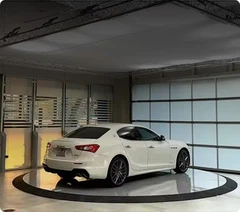
Let's say you're using a DAXLIFTER Customized Car Vehicle Rotary Rotating Stage Platform in a parking lot. If it has to rotate a large SUV, it won't spin as fast as when it's empty. That's just basic physics at work. The speed also needs to be controllable. You don't want the stage to suddenly go from zero to full speed. Instead, it should have a smooth acceleration and deceleration process.
2. Acceleration and Deceleration
Acceleration is how quickly the rotary stage can go from a stopped position to its set speed, and deceleration is the opposite. A good rotary stage should have a well - controlled acceleration and deceleration curve. This is important for a couple of reasons.
For one, if the acceleration is too sudden, it can cause vibrations. These vibrations can be a real problem, especially in applications where precision is key. In a microscopy setup, for example, vibrations can blur the image you're trying to capture. On the other hand, if the deceleration is too slow, it can waste time, especially in high - throughput manufacturing processes.
3. Positioning Accuracy
When it comes to dynamic performance, how accurately the rotary stage can stop at a specific position is crucial. This is called positioning accuracy. Even as the stage is in motion and then comes to a stop, it needs to end up exactly where it's supposed to.
There are different factors that can affect positioning accuracy. The quality of the encoder, which is a device that measures the rotation of the stage, plays a big role. A high - quality encoder can provide more accurate feedback to the control system, allowing for better positioning. Also, the mechanical design of the stage, like the quality of the bearings, can impact how well it can hold its position.
4. Repeatability
Repeatability is closely related to positioning accuracy. It refers to the stage's ability to return to the same position over and over again. In a manufacturing process, if you're using a rotary stage to drill holes in a part, you need the stage to rotate to the exact same position every time the part goes through the process.


A good rotary stage should have high repeatability. This means that even after multiple rotations and stops, the variation in the final position should be very small. Factors like wear and tear on the mechanical components can affect repeatability over time. That's why regular maintenance is so important.
Why Dynamic Performance Matters
In Manufacturing
In manufacturing, the dynamic performance of a rotary stage can have a huge impact on productivity and product quality. For example, in a CNC machining center, a rotary stage is used to position the workpiece accurately. If the stage has poor dynamic performance, like inconsistent rotation speed or low positioning accuracy, the machined parts might not meet the required specifications.
This can lead to increased waste and rework. On the other hand, a high - performance rotary stage can speed up the manufacturing process and ensure that the products are of high quality. It can also reduce the need for manual adjustments, saving both time and labor costs.
In Research
In research, especially in fields like astronomy and microscopy, precision is everything. In an astronomical telescope, a rotary stage might be used to point the telescope at different parts of the sky. If the stage has poor dynamic performance, it might not be able to accurately track a celestial object, making it difficult to collect reliable data.
In microscopy, a rotary stage is used to position the specimen. High - speed and accurate rotation can help researchers quickly scan a large area of the specimen, which is especially important in high - throughput screening applications.
Our Rotary Stages and Their Dynamic Performance
As a supplier, we take the dynamic performance of our rotary stages very seriously. We've invested a lot of time and resources in research and development to make sure our stages offer the best possible performance.
Our motors are carefully selected to provide the right balance of power and control. This allows our stages to achieve high rotation speeds while still maintaining smooth acceleration and deceleration. We also use high - quality encoders to ensure excellent positioning accuracy and repeatability.
And if you're in the automotive industry, you might be interested in our Floor To Floor Car Lift Platform. It's designed with the same attention to dynamic performance, ensuring smooth and accurate operation.
Contact Us for Your Rotary Stage Needs
If you're in the market for a rotary stage, whether it's for a manufacturing plant, a research lab, or an automotive application, we'd love to hear from you. Our team of experts can help you choose the right stage for your specific needs. We can also provide you with detailed information about the dynamic performance of our products and answer any questions you might have.
Don't hesitate to reach out and start a conversation. We're here to make sure you get the best rotary stage for your project.
References
- Johnson, A. (2018). Precision Motion Control in Industrial Applications. Industrial Press.
- Smith, B. (2020). The Science of Rotary Motion. Academic Publishers.


