


Two‑Post vs Four‑Post Vertical Car Parking System: Buying Guide For Home Garage & Commercial Parking Spaces
Limited parking spots in private garages and commercial real‑estate properties are a common challenge for many property owners. As land and parking space costs keep rising, expanding garage premises can be extremely costly. A vertical car parking system offers a practical alternative: it can double or even triple vehicle parking capacity without enlarging your building footprint.
Many buyers struggle to decide between a two‑post car lift and a four‑post car parking lift. Both models lift vehicles vertically for stacked parking, yet they feature completely different mechanical structures and serve distinct use‑cases. Poor equipment selection wastes capital and introduces potential safety hazards. Even after installation, the unit may fail to solve your real‑world parking pain points. This guide breaks down genuine differences between two‑post and four‑post parking lifts to help you pick suitable equipment based on your site conditions.

What Is a Two‑Post Vertical Car Parking Lift
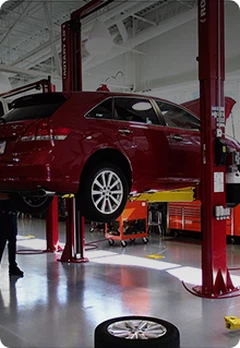
A two‑post car parking lift operates via two vertical support columns mounted on both sides of the parking bay. Once the vehicle is properly positioned, adjustable lifting arms cradle the vehicle chassis, working on a principle similar to service‑garage repair lifts. Activating the hydraulic assembly raises the whole car and frees up floor space underneath for a second vehicle to park.
It is a compact parking solution that occupies less floor area compared with four‑post units. It works perfectly for tight home garages and standard single parking bays. Two‑post lifts are widely adopted for domestic garages, small auto workshops and private classic‑car collections.
One major practical advantage is generous under‑car clearance for the lower parking spot. Since the upper vehicle is held suspended by lifting arms without a solid platform underneath, vehicles can drive straight into the lower bay. There are no height restrictions from platform thickness or entry ramps, even low‑profile sports cars can easily access the lower parking level.
What Is a Four‑Post Vertical Car Parking System
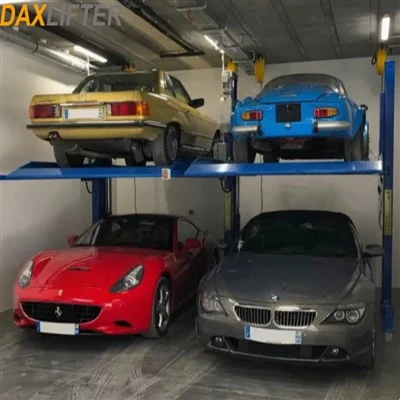
DAXLIFTER four‑post car parking system consists of four vertical support posts together with a full‑size solid vehicle platform. Vehicles drive fully onto the platform, which travels vertically as a complete unit. Vehicle weight gets evenly distributed across four anchor support points, delivering superior stability for heavy‑weight and long‑term stationary parking applications.

Four‑post lifts represent the mainstream choice for commercial parking environments. You will commonly find them at auto dealerships, vehicle storage warehouses and apartment complex garages. They easily accommodate SUVs, off‑road vehicles and commercial vehicles; selected models achieve maximum load capacity up to 6 tons.
Operation learning curve is minimal. Operators simply drive onto the platform and press control buttons to trigger lifting or lowering movements. New users can master the workflow with almost no training required.
Core Comparison: Two‑Post VS Four‑Post Vertical Car Parking Lift
Site & Space Requirements
- Two‑post lift: Support posts sit on both vehicle sides without consuming extra bay space. Fits standard single‑car garages with width 2.5‑3 meters. Minimum clear ceiling height of 3 m is strongly recommended.
- Four‑post lift: The integrated vehicle platform demands larger overall footprint. Minimum site width of 3.5 m is suggested, with roughly 3 m clear ceiling height. Larger footprint brings even weight distribution and more stable running performance.
Load‑Bearing Capacity
- Two‑post lift: Designed for passenger sedans and compact cars. Rated load normally ranges 2‑3 tons. Continuous parking of over‑weight vehicles risks structural damage and unsafe operation.
- Four‑post lift: Wide load‑capacity coverage from 3.6 tons up to 6 tons. Suitable for SUVs, off‑road vehicles, luxury large‑size cars and light commercial vehicles. DAXLIFTER FPL2718 and FPL2720 are heavy‑duty four‑post parking models built for high‑weight vehicles.
Lower‑Level Clearance & Low‑Chassis Vehicle Compatibility
- Two‑post lift: Upper vehicle hangs from lifting arms without solid platform. Generous vertical clearance on lower level, low‑profile sports cars enter and exit without difficulty.
- Four‑post lift: Solid platform occupies part of vertical height and reduces usable clearance for the lower bay. Platform thickness must be calculated during site planning if you frequently park low‑ground‑clearance vehicles.
Operation Ease‑of‑Use
- Two‑post lift: Requires precise positioning so lifting arms align exactly with chassis support points. Mis‑positioning may damage vehicles or create lifting hazards. Best‑suited for fixed, familiar single‑user operation.
- Four‑post lift: Extremely user‑friendly. Simply drive onto platform; no arm‑adjustment or chassis‑point alignment needed. Perfect for multi‑user shared scenarios such as apartment and commercial parking lots.
Safety & Structural Stability
- Two‑post lift: Safety performance heavily depends on correct lifting‑arm placement plus chassis strength. Safe under proper operation, yet better for rotating short‑term parking; long‑term multi‑day suspended vehicle storage is not recommended.
- Four‑post lift: Four posts combined with full platform spread vehicle weight evenly. Outstanding stability for long‑term static heavy‑vehicle parking. Proper installation greatly minimizes risks of offset or imbalance.
How To Decide Which Parking Lift Suits You
✅ Choose Two‑Post Vertical Car Parking Lift if:
- You own a home garage with narrow width, standard single‑car bay dimensions
- Mainly parking ordinary passenger sedans and light‑weight family vehicles
- You need ample under‑lift clearance for low‑profile sports cars on the lower parking spot
- Single fixed user who can consistently park vehicles with precise chassis‑point alignment
- You wish to keep initial procurement budget under control
✅ Choose Four‑Post Vertical Car Parking System if:
- You regularly park SUVs, off‑road trucks or heavy‑weight vehicles
- Application is commercial: auto shops, vehicle storage facilities, apartment complex parking garages
- Multiple different users share the unit; you prioritize simple, low‑threshold operation
- Vehicles require long‑duration static parking, high overall system stability is essential
- You have sufficient site dimensions and demand reliable heavy‑duty parking capacity
Multi‑Level Stacked Car Parking Solution
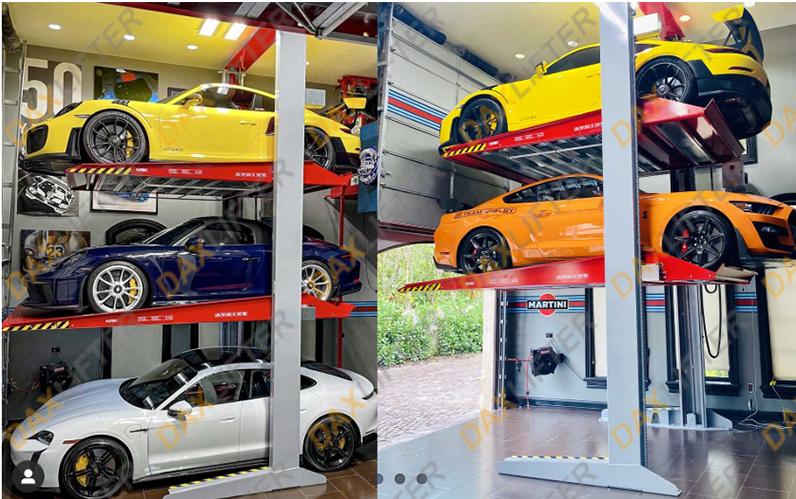
For extremely space‑limited parking bays, we supply 3‑level and 4‑level four‑post stacked vertical car parking systems. A single original parking bay can accommodate 3‑4 stacked vehicles. This solution gains great popularity among classic‑car collectors, high‑density apartment projects and commercial vehicle‑storage clients.

Installation & Critical Safety Reminders
Both two‑post and four‑post car parking lifts must be installed by certified professional crews following full safety specifications. Concrete floor must support combined weight of equipment plus parked vehicles. Most installation cases require concrete strength no lower than 32 MPa with perfectly flat finished floor surfaces.
Before installation, verify ceiling height, local power supply and site drainage conditions. On‑site survey and pre‑planning steps cannot be skipped. You can share site photos and dimension measurements with our engineering team for feasible customized proposals.
Cost & Long‑Term Value Considerations
Two‑post lifts come with lower entry‑level purchase price which appeals to residential buyers. Do not base your choice merely on upfront quotation. If you frequently park heavy vehicles or run high‑frequency commercial operations, four‑post units demand higher initial investment yet deliver superior durability and long‑term operational value.
Both categories share comparable ongoing maintenance expenses. Regular scheduled service plus periodic inspection for hydraulic circuits and safety locking mechanisms guarantee stable long‑term running. Good cost‑performance never means skipping routine maintenance; proper servicing effectively extends total equipment service life.
Final Summary
Choosing between two‑post and four‑post vertical car parking systems depends on your actual conditions: vehicle types, operator profiles, garage dimensions and daily usage frequency.
For most home garages with limited bay width storing regular passenger cars, two‑post lifts offer good cost‑performance and space‑saving benefits. For commercial projects, multi‑car collections and heavy‑vehicle parking, the stability and load‑capacity advantages of four‑post parking lifts justify your investment.
Get Custom Vertical Car Parking System Solutions From DAXLIFTER
Still uncertain which parking lift fits your project? Our technical team provides targeted equipment recommendations based on real‑world project experience rather than theoretical parameter comparison. Whether you plan residential‑garage renovation or full‑scale commercial parking‑lot planning, we deliver tailored parking‑system proposals.
WhatsApp / Phone: +86 15192782747
Email: sales@daxlifter.com
Share your parking‑space requirements with us and receive professional suggestions and exclusive quotations!